
Disclosure Based on TNFD Recommendations
1. Introduction
Currently, the world is making a major shift toward the shared goal of achieving 'nature positivity' to halt biodiversity loss and put it on a recovery track by 2030. The 'Kunming-Montreal Biodiversity Framework', adopted in 2022, calls for transformative changes in social and economic practices, and the conservation of natural capital is no longer just about risk management; it is an essential condition for sustainable growth.
As a company that supports the development of a digital society through the supply of silicon wafers for semiconductors, the SUMCO Group is committed to realizing a sustainable society in harmony with nature under the 'SUMCO Basic Environmental Policy', in order to pass on to future generations the benefits derived from healthy ecosystems. As part of this, we support the principles of the Task Force on Nature-related Financial Disclosures (TNFD) and will transparently communicate our dependence and impact on natural capital, as well as the associated risks and opportunities, through information disclosure based on this framework.
2. Risk and opportunity assessment process in natural capital
The SUMCO Group recognizes its dependencies on and impacts to natural capital in its business activities and has identified nature-related issues and developed response strategies based on the TNFD Recommendations*1 and the 'LEAP Approach'*2 recommended by TNFD, with the aim of maintaining and enhancing long-term corporate value.
The LEAP approach is a method that systematically addresses nature-related challenges through the following four processes.
- Taskforce on Nature-related Financial Disclosures (TNFD) Recommendations
- Guidance on the identification and assessment of nature-related issues: the LEAP approach
- Locate (Discovering Connections with Nature)
Identify potential nature-related issues in your business activities, including the supply chain, identify the source locations of such issues, and determine their priorities. - Evaluate (Dependence and Impact Assessment)
We quantitatively and qualitatively assess the benefits that business activities receive from nature (dependencies) and the effects they have on ecosystems (impacts) at the identified points of interaction with nature. - Assess (Risk and Opportunity Assessment)
Based on the assessment of dependencies and impacts, we identify physical risks, transition risks, and nature-related business opportunities that affect business continuity. - Prepare (Preparation for Response and Reporting)
We reflect on the analysis results in our management strategies and resource allocation, and prepare for information disclosure to stakeholders.
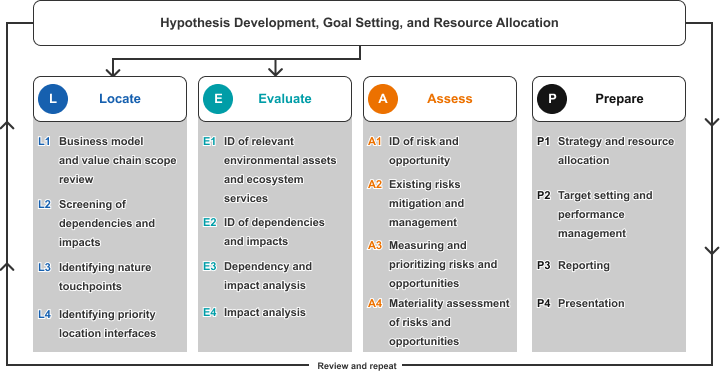
FY2025, we conducted the entire process of the LEAP approach on a trial basis. The material issues identified at this stage are disclosed below as the foundation of the SUMCO Group's strategy. Looking ahead, the SUMCO Group plans to gradually integrate the results of this analysis into our governance and risk management systems.
Locate (Discovering Connections with Nature)
Screening of Dependencies and Impacts
The SUMCO Group conducted a dependence and impact assessment on natural capital covering the entire value chain (upstream, direct operations, downstream) of the single segment 'Manufacturing and Sales of Silicon Wafers for Semiconductors'. Using the international evaluation tool 'ENCORE*3', we analyzed the 'dependence' and 'impact' of business activities on nature within the value chain. Based on this analysis, we identified business activities in the value chain and direct operations where dependencies and impacts were found to exceed a certain threshold as 'priority business activities for assessment’ and created a heat map to visualize the dependencies and impacts.
- ENCORE (Exploring Natural Capital Opportunities, Risks and Exposure):
A tool developed by UNEP-WCMC and others for assessing dependencies and impacts on natural capital. It enables the identification of both ecosystem services enjoyed (dependencies) and pressure drivers on nature (impacts) for each business sector.
-
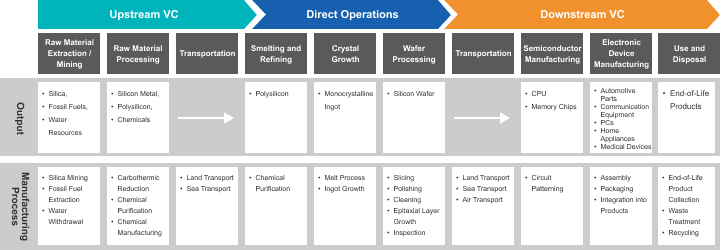
Figure 2. Value Chain Diagram -
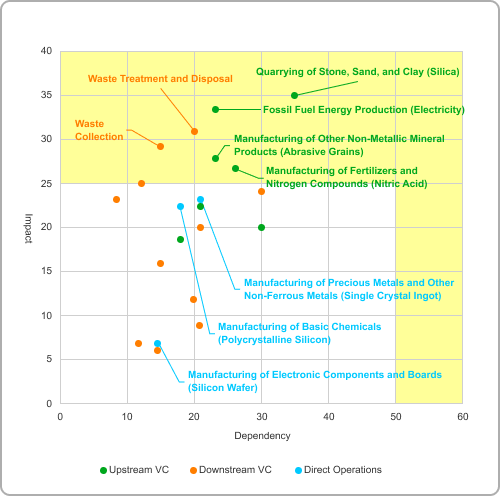
Figure 3. Dependence and Impact Score map -
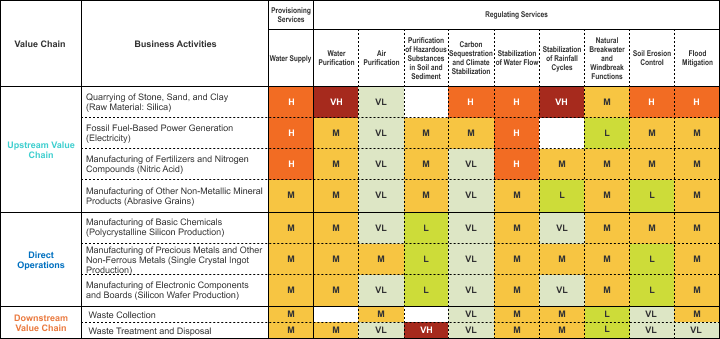
Figure 4. Heat Map of Dependencies on Nature -
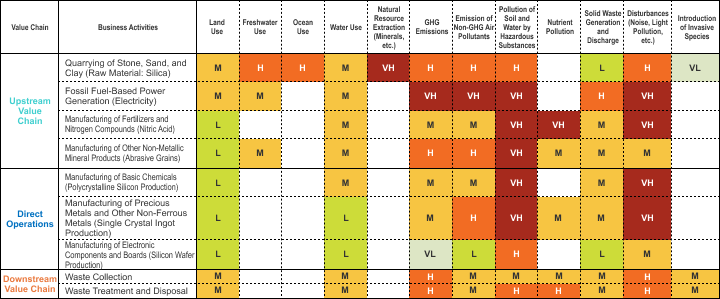
Figure 5. Heat Map of Impacts on Nature
-
Upstream:
A high dependence on stable 'water supply' was confirmed in sectors such as quartzite mining, which serves as the primary raw material for silicon wafers, and energy production. Furthermore, it was confirmed that 'regulating services' provided by ecosystems, such as climate regulation and water flow regulation, serve as an essential foundation supporting business sustainability throughout the entire value chain.
As for the primary impacts on nature, we identified land use changes associated with resource extraction and the discharge of pollutants.
-
Direct operation:
The silicon wafer manufacturing process requires large volumes of clean water. A defining characteristic of this process is its high dependence on the supply and regulation functions of these water resources.
Regarding the primary impacts on nature, we identified the discharge of pollutants into the air and water during the manufacturing process, as well as the impacts on wildlife caused by noise and other factors associated with operations.
-
Downstream:
Dependencies on the purification and remediation services of nature were confirmed at the disposal and recycling stages of process by-products and products.
Regarding the primary impacts on nature, we identified the discharge of pollutants during waste treatment processes, as well as physical disturbances such as noise and light pollution associated with treatment operations.
As a result of the analysis using ENCORE, it was confirmed that dependencies and impacts on nature are greatest in the upstream value chain. However, considering the current challenges in ensuring traceability in the upstream value chain and the limitations of available data, we have decided to limit the scope of this detailed analysis and identification of priority locations to 'our own operational sites,' where we have direct management control.
Identification of Priority Locations
The SUMCO Group assessed the environmental characteristics of the regions where its business sites are located and identified priority locations requiring focused attention, with the aim of gaining a more concrete understanding of nature-related risks and opportunities.
In this phase, we evaluated all manufacturing and research and development sites within the direct operational scope of The SUMCO Group — comprising 11 domestic sites and 6 overseas sites, totaling 17 sites. In conducting the assessment, we identified the relevant biomes based on the location data of each site and then evaluated whether each site met the criteria for 'ecologically sensitive areas' as defined by TNFD.
Criteria for Ecologically Sensitive Areas
- Areas of importance for biodiversity: Areas adjacent to protected areas or habitats of rare and endangered species
- Areas of high ecosystem integrity: Areas where the natural state of ecosystems is well maintained
- Areas of degraded ecosystem integrity: Areas where ecosystem destruction or deterioration is progressing
- Areas of high physical water risk: Areas exposed to risks such as water scarcity, water pollution, and flooding
- Areas of importance for ecosystem service provision: Areas where the ecosystem services on which our business depends are equally vital to local communities
For the analysis tools, we used external databases such as the globally recognized 'WWF Biodiversity Risk Filter'*4 to qualitatively score regional characteristics at each site.
- WWF Biodiversity Risk Filter:
A tool developed by the World Wide Fund for Nature (WWF) to assess biodiversity risks at business sites and supply chains. Based on location information at the site, it is possible to visualize physical, regulatory, and reputation risks.
As a result of the analysis, 8 out of the 17 sites assessed were identified as priority locations requiring focused attention.
Table 1. Identified Priority Locations
| Business Locations | Address | Reason for Selection |
|---|---|---|
| Kyushu Factory (Nagahama, Imari) | Imari-shi, Saga | Adjacent*1 to a protected area for Critically Endangered Horseshoe Crab. |
| Kyushu Factory (Kubara, Imari) | Imari-shi, Saga | Adjacent to a protected area for Critically Endangered Horseshoe Crab. |
| Kyushu Factory (Saga) | Kohoku-machi, Kishima-gun, Saga | Adjacent to a Key Biodiversity Area (KBA*2) (Rivers and Ponds of Chikushi Plain). |
| High-Purity Silicon Corporation (Suzuka) | Suzuka-shi, Mie | Adjacent to a Key Biodiversity Area (KBA) (Estuary of Ano River and Shidomo River). |
| PT.SUMCO Indonesia | Cikarang, Bekasi, West Java, Indonesia | Located in a high-risk area for air pollution, water stress, and water pollution. |
| SUMCO Phoenix Corporation | Phoenix, Arizona, USA | Located in an arid area with high water stress and water depletion risks. |
| SUMCO Southwest Corporation | Phoenix, Arizona, USA | Located in an arid area with high water stress and water depletion risks. |
| SUMCO Phoenix Corporation Albuquerque | Albuquerque,NewMexico, USA | Located in an arid area with high water stress risk. |
- Areas within approximately 5 km in a straight line were defined as 'adjacent.'
- KBA: Key Biodiversity Areas. Regions that significantly contribute to the global sustainability of biodiversity in terrestrial, freshwater, and marine ecosystems.
For these identified priority locations, we will focus on conducting more detailed analyses in 'Evaluate' (Dependence and Impact Assessment) and 'Assess' (Risk and Opportunity Assessment).
Evaluate (Dependence and Impact Assessment)
We conducted a detailed survey of inputs and outputs in the business processes, as well as environmental management items, for the 8 priority locations identified in the Locate phase. In this phase, we are examining dependencies and impacts on nature in detail based on these actual data.
Dependence on nature
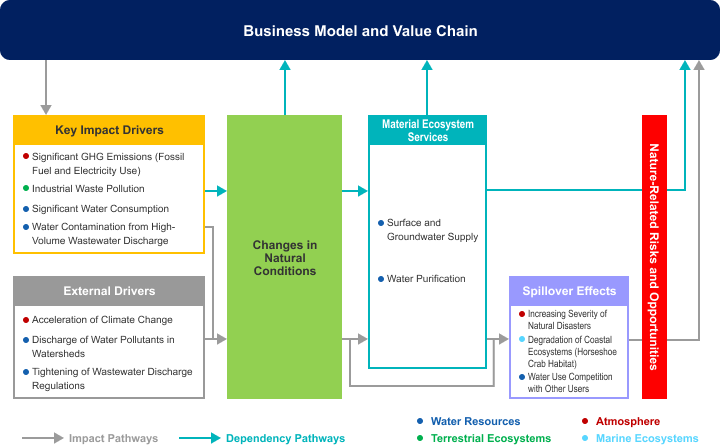
The SUMCO Group’s silicon wafer manufacturing is built upon specific ecosystem services, and their stability forms an indispensable foundation supporting the stable supply of silicon wafers. The primary dependencies are as follows.
- High dependence on water supply services:
Large volumes of clean water are required for the pulling of high-purity ingots and the precision polishing and cleaning processes of wafer surfaces. The dependence on 'water supply services' is extremely high across all sites, and the stable securing of freshwater is a critical issue that directly affects production capacity. - Dependence on Water Quality Regulation and Natural Purification:
While we conduct appropriate wastewater treatment in compliance with applicable laws and regulations, we depend on the natural self-purification capacity of rivers and oceans — the final receiving bodies of our treated effluent — including their 'water purification functions' and 'dilution and dispersion functions.' These functions are important elements in reducing the environmental burden on surrounding areas and maintaining the water cycle.
Impact on Nature
The SUMCO Group’s business activities involve a certain level of environmental burden in the manufacturing process, which has direct and indirect impacts on climate change and the state of local ecosystems. The primary impacts on nature are as follows.
- Impact on atmospheric conditions due to energy consumption:
Through the consumption of large amounts of electricity, which is essential for silicon wafer manufacturing, we emit greenhouse gases (GHGs). We recognize this as an impact that contributes to climate change and may indirectly lead to the degradation of global natural capital. - Impact on water resources and local ecosystems:
In addition to our contribution to local water stress through large volumes of water intake, we are closely monitoring the potential thermal load and water quality changes that treated effluent may have on the surrounding environment. In particular, in areas rich in biodiversity — such as the Imari-Saga area, known as a breeding ground for horseshoe crabs — we continue to implement strict wastewater management in order to minimize the burden on their habitat. - Resource Circulation and Pollutant Emissions
The large volumes of industrial waste generated in the manufacturing process, as well as nitrogen oxides (NOx) from boiler operations and the discharge of various chemical substances, are factors that contribute to the degradation of land and air quality. In response to these impacts, we are working to reduce the environmental burden through thorough resource recycling and emission controls.
External Factors That May Alter the Availability of Ecosystem Services
In addition to our own direct impacts, we have identified the following changes in the external environment as impacts that threaten the availability of the ecosystem services on which we depend.
- Changes in laws and regulations related to water use and wastewater discharge:
Should the legal framework governing water resource use and wastewater management become more specific and stringent in the future, the permissible capacity for 'natural self-purification functions (dilution and dispersion functions)' and other ecosystem services on which we depend may be substantially limited, potentially becoming a constraining factor in the sustainable utilization of current ecosystem services. - Acceleration and intensification of climate change:
Climate change leads to the intensification of weather-related disasters such as heavy rainfall and typhoons caused by global warming and becomes a factor that directly alters regional water cycles. For example, in the event of large-scale flooding, it poses a pressure that destabilizes the 'stable supply of clean water' — the lifeline of silicon wafer manufacturing — through factors such as intake restrictions caused by a rapid rise in river water turbidity, damage to water intake and conveyance infrastructure, and supply disruptions due to power outages.
Assess (Assessment of Risks and Opportunities)
In the Assess phase, we conducted a comprehensive evaluation of how the dependencies and impacts on nature identified through previous analyses give rise to risks and opportunities for our business activities.
The SUMCO Group extracted anticipated nature-related 'risks' and 'opportunities' for our direct operations in priority locations and the associated value chain. For each item, we qualitatively assessed the likelihood of future occurrence and the degree of impact on our finances and strategy. Through this process, we identified significant risks and opportunities that should be addressed as management priorities and examined specific response measures.
Table 2. Key Risks and Countermeasures
| Risk | Classification | Dependency/Impact/External Factor | Risks | Timing of embodiment*1 | Possibility*2 | Degree of impact*3 | Risk Responses | Metrics & Targets |
|---|---|---|---|---|---|---|---|---|
| Physical risk | Acute | GHG Emissions (Impact) | Operational disruption risk across the value chain due to intensifying storm and flood hazards. | Short term | Medium | Large |
|
A8.0 Description and value of assets/total annual revenue dependent on area affected by physical risk |
| Physical / Transition risk | Chronic / Regulatory & Policy / Market | Water Use (Impact) / Water Purification & Supply (Dependency) | Risk of supply disruption and cost increase due to reduced water availability and tightening water regulations. | Medium to long term | Medium | Large |
|
C3.0 Withdrawal and Consumption from Water-Stressed Areas |
| Transition risk | Regulatory & Policy / Market | GHG Emissions (Impact) | Value chain-wide cost increase risk due to carbon pricing introduction and decarbonization policy advancement. | Medium to long term | Large | Medium |
|
GHG Emissions (Scope1,2,3) |
| Reputation / Market | Solid Waste Generation (Impact) | Cost increase risk associated with recycling compliance. | Medium to long term | Large | Medium |
|
C2.2 Total Hazardous and Non-Hazardous Waste by Type (Tons) *By Disposal Method |
Table 3. Key Opportunities and Countermeasures
| Classification | Dependency/Impact/External Factor | Opportunities | Timing of embodiment*1 | Possibility*2 | Degree of impact*3 | Opportunity Responses | Metrics & Targets |
|---|---|---|---|---|---|---|---|
| Resource Efficiency | Solid Waste Generation (Impact) | Low-waste production processes drive cost reduction and improved competitiveness. | Medium term | Large | Medium |
|
C2.2 Total Hazardous and Non-Hazardous Waste by Type (Tons) *By Disposal Method |
| Reputation | Nutrient & Water Pollutant Discharge (Impact) | Conservation of rare species in effluent discharge areas builds local community trust and enhances business continuity stability. | Short to long term | Large | Medium |
|
C1.1 Voluntary Conservation / Restoration Area (km2) |
| Products and Services | GHG Emissions (Impact) | Increased demand for high-value-added silicon wafers and market share expansion driven by GX/DX advancement. | Medium to long term | Large | Large |
|
C7.4 Revenue Increase and Share from Nature-Positive Products and Services, and Description of Impacts. |
| Products and Services | GHG Emissions (Impact) | Increased demand for energy-saving equipment driven by energy efficiency and renewable energy advancement. | Long term | Large | Large |
|
C7.4 Revenue Increase and Share from Nature-Positive Products and Services, and Description of Impacts. |
- Timeline (aligned with TCFD)
Short-term: within 1 year, Mid-term: 1–3 years, Medium-long: 3–10 years, Long-term: Over 10 years - Occurrence is classified as the designated level if at least one of the following conditions is met
- High
- Frequently occurred in the past or has occurred multiple times in recent years
- Due to changes in the external environment, the likelihood of future occurrence is extremely high or reasonably anticipated
- Medium
- There have been past cases of such incidents
- Based on scientific findings and policy trends, future occurrence cannot be ruled out and is expected to some extent
- Low
- Never occurred in the past
- The probability of future occurrence is extremely low, or realistically difficult to anticipate
- High
- Financial Impact Degree
Large: Over 10 billion yen, Medium: 1 billion yen-10 billion yen, Small: Up to 1 billion yen
Prepare (Preparation for response and reporting)
In the Prepare phase, we formulated and prioritized specific response measures to address the significant dependencies and impacts, as well as the risks and opportunities identified through the preceding Locate, Evaluate, and Assess processes.
In implementing response measures to address the identified nature-related risks and impacts, The SUMCO Group has adopted the 'AR3T Framework'*5. This is a framework for systematically implementing measures based on the following order of priority, rather than responding reactively to issues as they arise.
- AR3T Framework (Avoid, Reduce, Restore & Regenerate, Transform):
A hierarchy of actions for addressing negative impacts on nature, advocated by the Science Based Targets Network (SBTN). It consists of four stages — 'Avoid,' 'Reduce,' 'Restore & Regenerate,' and 'Transform' — and serves as a framework aimed at contributing to nature positive outcomes.
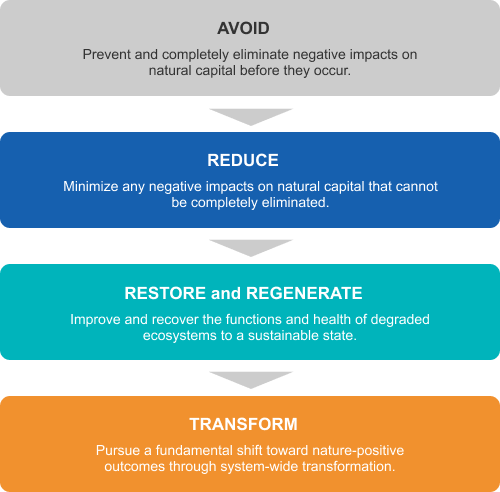
Based on this order of priority, we will promote highly effective actions that minimize negative impacts on natural capital and maximize our contribution to nature positive outcomes. Regarding specific response measures for each risk and opportunity, as outlined in the preceding chapter's 'Table 2: Key Risks and Countermeasures' and 'Table 3: Key Opportunities and Countermeasures,' we will steadily implement initiatives such as the advancement of water recycling and local ecosystem conservation activities.
3. Future Outlook and Challenges
The identification and assessment of nature-related issues through the LEAP approach have been an important process for the SUMCO Group — one that allowed us to reaffirm the value of natural capital as the foundation of our business, and to critically examine its sustainability.
The fact that the highly precise manufacturing of silicon wafers is built upon abundant water resources and healthy ecosystem services once again underscores the magnitude of our responsibility for future generations. The disclosures in this report represent only a first step, and going forward, the SUMCO Group will further strengthen business resilience by more deeply integrating the dependencies, impacts, risks, and opportunities identified in this report into its management strategy and governance framework. We will also deepen dialogue with diverse stakeholders, including local communities, and strengthen collaboration toward nature restoration and recovery across the entire value chain.
As a global leader supporting the most upstream segment of the semiconductor supply chain, we are committed to achieving both technological innovation and the conservation of natural capital at the highest level, and to continuing to contribute to the development of a sustainable society.