
Health and Productivity Management Initiatives
The SUMCO Group's Approach to Employees' Health
The SUMCO Group embraces the philosophy that “the safety and health of our employees take precedence over everything else.” We are committed to building an excellent company with a strong profit mindset by cultivating a workplace where employees can thrive both physically and mentally. In line with this commitment, we have issued the “SUMCO Health Declaration” to stakeholders inside and outside the company, and we strategically promote health initiatives as future-oriented investments that drive sustainable growth, rather than treating them merely as welfare benefits.
Chief Health Officer (CHO) ・Shinichi Kubozoe
SUMCO Group Health Declaration
The SUMCO Group recognizes employee's health as one of its most valuable management resources.
By empowering each employee to take an active role in maintaining and improving their own health, while advancing organization-wide health initiatives, we strive to create a corporate group where every employee can thrive.
Our KGIs and KPIs
The Company’s KGIs (Key Goal Indicators: final outcome targets) for health and productivity management consist of five evaluation factors: improving productivity through reducing presenteeism and absenteeism, and realizing an energetic working environment for employees through enhancing work engagement, job satisfaction, and sense of fulfillment at work. Achievement of three or more of these five factors is defined as attainment of the KGIs.
To support this, KPIs (Key Performance Indicators) are set as specific numerical targets, including improvement of the comprehensive health risk adjusted by effort-reward ratio and an increase in the percentage of employees improving their lifestyle habits, and are evaluated quantitatively.
Of the five KGI indicators established as targets for 2025, we achieved the targets for two indicators—absenteeism and job satisfaction—by the end of 2025. Regarding sense of fulfillment at work, the score also improved by 5.5 points compared with 2020, reaching a level 0.6 points short of the target value.
On the other hand, because we did not achieve the KGI attainment criterion of “achievement of three or more indicators,” we have conducted factor analysis for the indicators that did not achieve their targets and are strengthening improvement measures.
Going forward, toward achieving the newly established 2030 targets, we will systematically promote initiatives based on the results and challenges identified through our efforts to date.
SUMCO’s KGIs
| Item | 2021 Results |
2022 Results |
2023 Results |
2024 Results |
2025 Results |
2030 Targets |
Notes |
|---|---|---|---|---|---|---|---|
| Presenteeism | 4.20 | 4.00 | 3.80 | 4.00 | 3.9 | 3.5 | *1 |
| Absenteeism | 4.30 | 4.90 | 4.40 | 3.90 | 3.5 | 3.3 | *2 |
| Work Engagement | 2.60 | 2.63 | 2.61 | 2.57 | 2.53 | 2.63 | *3 |
| Job Satisfaction | 63.40 | 65.70 | 68.90 | 68.70 | 68.9 | 70.0 | *4 |
| Sense of Fulfillment at Work | 61.90 | 64.00 | 67.30 | 66.80 | 67.4 | 70.0 | *5 |
- Presenteeism
Average number of days on which employees reported coming to work despite being in a health condition that would have been better suited for taking leave during the past 12 months
● Target by the end of FY2025: Presenteeism of 3.5 days - Absenteeism
Average number of days on which employees reported being absent from work due to illness or health-related reasons during the past 12 months (including annual paid leave)
● Target by the end of FY2025: Absenteeism of 4.0 days - Work engagement
Average score of employee surveys consisting of nine work-related questions (seven-point scale from 0 to 6)
● Target by the end of FY2025: 2.75% - Job satisfaction
Percentage of employees who responded “Satisfied” or “Somewhat satisfied” to the question regarding satisfaction with their work
● Target by the end of FY2025: Job satisfaction of 68% - Sense of fulfillment at work
Percentage of employees who responded “Agree” or “Somewhat agree” to the statement that their work is fulfilling
● Target by the end of FY2025: Sense of fulfillment at work of 68%
Health Promotion Framework
-
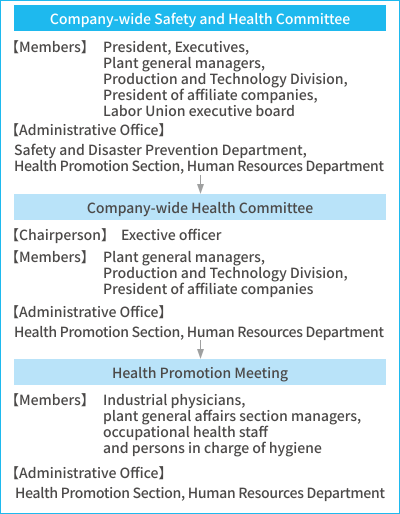
Health Promotion-related Meetings
-
In the semiconductor industry, where global competition demands the highest levels of reliability and quality, it is vital that every employee performs to their full potential. The SUMCO Group convenes regular company-wide Safety and Health Committees, Health Committees, and Health Promotion Meetings to review site-level activities and progress against health-related KPIs. The insights gained from these forums are systematically reflected in new initiatives and continuous improvements.
We have also established a robust support framework led by highly specialized professionals. This framework promotes individual health guidance, smoking cessation support, workplace environment improvements informed by stress checks, and mental health training, all in collaboration with our health insurance society and labor union. Additionally, we are collaborating with our business partners on health and hygiene activities (such as gathering opinions at meetings) and sharing our health management expertise.
Through these initiatives, we advance a continuous PDCA cycle of health management, where progress on KPIs drives the achievement of our KGI, ultimately strengthening both employee vitality and corporate competitiveness. In this way, our health management serves as a foundation for sustainable growth and enhanced corporate value in the global market, while upholding the “high safety and reliability” demanded of the semiconductor industry.
Assignment of occupational health staff
| Sites | Chitose Plant | JSQ Division | Yonezawa Plant | Tokyo/Osaka/Fukuoka | Kyushu Factory (Imari, Nagahama) | Kyushu Factory (Imari, Kubara) | Kyushu Factory (Saga) | SUMCO Technology Corp. Noda Plant | High-Purity Silicon Corp. (Yokkaichi) | SUMCO TECHXIV Corp. (Nagasaki) | SUMCO TECHXIV Corp. (Miyazaki) |
|---|---|---|---|---|---|---|---|---|---|---|---|
| Occupational health staff | 1 | 1 | 1 | 1 | 3 | 3 | 1 | 1 | 1 | 3 | 1 |
Health and Productivity Management Initiatives
-


-
We promote initiatives to maintain and improve the health of each employee as a company through various well-planned company-wide initiatives.
Our initiatives for the health of each employee have been recognized, and we were selected for the fourth time as a “Health and Productivity Stock,” a designation jointly selected by the Ministry of Economy, Trade and Industry (METI) and the Tokyo Stock Exchange from among listed companies that excel in health and productivity management.
Our initiatives for the health of each employee have been evaluated and SUMCO Group has been certified as one of the "White 500" corporations under "the Certified Health & Productivity Management Outstanding Organization Recognition Program" sponsored by the METI and The Nippon Kenko Kaigi for the eight consecutive years since 2019.
Our Health Management Challenges
We focus on three health management issues in particular: "1. mental health," "2. smoking cessation," and "3. lifestyle-related diseases," set target values, create medium- to long-term plans, and carry out activities.
1. Mental Health
SUMCO believes that maintaining good mental health among employees leads to the development of a workplace environment where employees meet the high demands of customers, be highly productive and work with vitality. As a part of the primary prevention of mental health issues, since 2003 SUMCO has been operating and assessing workplace environment improvement activities as part of its occupational safety and health management system (OSHMS).
In addition, based on the results of stress checks conducted regarding workplace environment improvements at each workplace, we have each employee exchange feedback aimed at improvements to be made within the workplace, decide on and implement action items, and post effective initiatives on the company intranet site.
- FY2026 Satisfaction Rate: 84.4% (Percentage of respondents who rated "Neutral" or higher on a 5-point scale)
Main Action Items
- Mental health training (stratified training, e-learning) and consultation framework for counselors and other staff
- Workplace environment improvement activities based on stress check results
Case Studies of Activities
Workplace Environment Improvements Based on Stress Check Results
In the SUMCO Group, departments whose stress check results show higher loads in the analysis are voluntarily improving the workplace environment by their respective departments within the framework of OSHMS. As an example of improvement activities, there is a case where the leader of a workplace where long working hours continued created and executed a Fault Tree Analysis (FTA), reviewed the results, and evaluated the effectiveness of the countermeasures. We succeeded in earlier leaving times for each employees and reduction of overtime hours by adjusting work volume and personnel, redistributing tasks among employees, and implementing initiatives such as posting messages on workplace bulletin boards to reduce overtime hours in order to foster awareness towards reducing working hours and monitoring the utilization of regular leaving days. In addition to these efforts, the SUMCO Group promotes initiatives that respect the employees’ work-life balance, such as tracing the annual paid leave utilization rates and encouraging them to take annual leave.
Results of Activities
| Item | 2021 Results |
2022 Results |
2023 Results |
2024 Results |
2025 Results |
2030 Target |
Notes |
|---|---|---|---|---|---|---|---|
| ERI-adjusted general health risk | 103 | 98 | 89 | 87 | 90 | 87 or below | *6 |
| Higt-Stress Rates | 14.2 | 13.5 | 11.8 | 12.0 | 13.6 | 10.0 | *7 |
- ERI-adjusted comprehensive health risk is calculated by incorporating evaluation results based on the Effort-Reward Imbalance (ERI) model into the comprehensive health risk.
- High-Stress Rates= Number of high-stress employees / Number of employees surveyed
- Definition of high-stress employees
Using the Brief Job Stress Questionnaire (57 items), employees who meet either criterion a or b below are defined as high-stress employees.- For the six scales of “Mental and Physical Stress Responses” (29 items)—vigor, irritation, anxiety, depression, fatigue, and physical complaints—responses are converted into a five-point scale (1 point indicating higher stress and 5 points indicating lower stress), and employees with a total score of 12 points or less across the six scales.
- For the 12 scales consisting of the nine scales of “Job Stressors” (17 items)—including workload, job quality, and physical burden—and the three scales of “Support from Others” (nine items)—including support from supervisors and colleagues—responses are converted into a five-point scale using the raw score conversion table, and employees with a total score of 26 points or less across the 12 scales and a total score of 17 points or less for the six scales of “Mental and Physical Stress Responses.”
| Item | 2021 Results |
2022 Results |
2023 Results |
2024 Results |
2025 Results |
Notes |
|---|---|---|---|---|---|---|
| Comprehensive Health Risk | 103 | 100 | 97 | 96 | 97 | *8 |
| Number of Employees Taking the Stress Check | 5,984 | 6,478 | 6,936 | 7,267 | 7,208 | *9 |
| Stress Check Participation Rate | 98.6% | 97.3% | 98.0% | 99.0% | 99.1% | *10 |
- Comprehensive health risk is calculated using the Job Stress Assessment Diagram based on the stress survey.
- Number of employees taking the stress check = Number of employees measured for absenteeism, presenteeism, and work engagement
- Stress check participation rate = Response rate for absenteeism, presenteeism, and work engagement surveys
2. Activities to Encourage Smoking Cessation
In January 2020, a survey on smoking was conducted among all Group employees. Trend analysis was conducted on factors such as smoking frequency and number of smoking sessions by employees who are smokers, and as a result of conducting smoking cessation training and individual health guidance in light of the various traits and age groups, the smoking rate among the Group employees has diminished by 16.1% during these eight years, from 46% in 2018 to 29.9% in 2025.
Additionally, from the perspective of maintaining and promoting employee health, we implemented the closure of all smoking areas within SUMCO premises. We are also fully offering outpatient treatment for smoking cessation and subsidies for the purchase of smoking cessation aids through the health insurance system. With these measures, we are helping employees attempt smoking cessation without their financial burden.
- FY2026 Satisfaction Rate:79.1% (Percentage of respondents who rated "Neutral" or higher on a 5-point scale)
Main Action Items
- Trend analysis based on results of survey of all employees on smoking
- Smoking cessation training based on the results of the above survey and encouraging the use of smoking cessation treatment through individual health guidance (Free company-subsidized smoking cessation treatment)
- Subsidies for the purchase of smoking cessation aids
- Workplace anti-smoking challenge race (Kyushu Factory)
- Closure of smoking areas on company-premises
- Individual smoking cessation guidance provided by health staff (In fiscal year 2024, 60 out of 652 participants successfully quit smoking)
- Smoking cessation education
- Lectures by medical specialists for smokers and smoking cessation supporters, including managers (Nagasaki and Miyazaki)
- Lectures by employees sharing their smoking cessation experiences (Yonezawa and Noda)
Case Studies of Activities
At the SUMCO Group, in addition to initiatives such as smoking cessation surveys and educational programs for all employees, we hold events at each site to promote smoking cessation and develop measures that encourage employees to approach smoking cessation positively.
Along with approaches targeting groups, our occupational health staff also provide individualized support. Even for employees who attempted to quit smoking but resumed smoking, or those who are not currently considering smoking cessation, we continue to provide support tailored to each individual’s circumstances, including changes in life stage.
In 2025, we also provided information on smoking cessation support programs to employees’ families. Through support from multiple perspectives, we develop and implement measures that encourage voluntary smoking cessation.
Results of Activities
| Item | 2021 Results |
2022 Results |
2023 Results |
2024 Results |
2025 Results |
2030 Targets |
|---|---|---|---|---|---|---|
| Current smoker | 31.9% | 31.9% | 31.5% | 30.7% | 29.9% | 25.0% |
3. Measures to Address Lifestyle-related Disease, Other Initiatives
-

-
The results of periodic medical checkups show that the percentage of employees with metabolic syndrome increases between the ages of 30 and 40. We therefore offer health classes and health guidance to employees before the age of 40 to improve their lifestyles. Furthermore, at our Kyushu Factory (Saga Prefecture), we hold health classes for employees aged 39 with the cooperation of external managerial dietitians and the Slow Jogging Association. Through dietary guidance and the practice of slow jogging®, we verify the effectiveness of these classes, which will lead to improved guidance for the following year. In 2025, a survey conducted three months after the introduction of slow jogging® in the 39-year-old health classes showed a significant improvement in exercise habits.
As part of our initiatives to promote exercise habits, we hold company-wide walking events every year, tailored to the characteristics of each region. The number of participants is increasing, and the percentage of employees who regularly exercise for 30 minutes or more is thus trending upward, demonstrating positive outcomes as an initiative to encourage behavioral change among employees.
Additionally, due to the advancing age structure of the workforce, we assume that incidents of falls and trips will increase. To address this, we have assessed the motor functions of employees in a joint initiative with the Department of Sports Science at Fukuoka University to develop the SUMCO Fall Prevention Exercises and implement them in-house. In addition, as part of measures to ensure the health of female employees, we conduct surveys targeting all female employees to understand their needs, and implement initiatives such as providing free health classes, conducting free Equol tests, and offering company assistance programs for cancer screenings.
In 2025, we were certified as a Sports Yell Company in recognition of our proactive initiatives to promote employee health through sports activities. Our company-wide walking events that enhance physical and mental well-being, as well as the implementation of radio calisthenics and SUMCO Fall Prevention Exercises conducted before and during working hours, have received recognition.
- FY2026 Satisfaction Rate: 89.7% (Percentage of respondents who rated "Neutral" or higher on a 5-point scale)
Main Action Items
- Walking events
- FY2026 Satisfaction Rate: 85.3% (Percentage of respondents who rated "Neutral" or higher on a 5-point scale)
- Health classes for employees at age 39 (Kyushu Factory)
- Education on improving dietary habits
- Individual health guidance
- Follow-up support for specific health guidance
- Distribution of leaflets on lifestyle-related diseases
Case Studies of Activities
At the Kyushu Factory, we provide lifestyle improvement education for employees aged 30, 35, and 39, and assess their health literacy. Employees aged 30 and 35 record their daily calorie intake, while those aged 39 evaluate their own dietary habits through practical meal exercises, with changes tracked using the eHEALS (eHealth Literacy Scale). In addition, we conduct annual surveys on dietary habits covering company cafeterias and vending machines. We also apply nudging techniques in cafeteria layouts to encourage employees to more easily choose salads and side dishes.
We also provide opportunities to learn about improving dietary habits in an engaging manner through lectures and group discussions led by registered dietitians.
Furthermore, we support employees in maintaining healthy dietary habits by using urine test kits to assess nutritional status.
Results of Activities
| Item | 2021 Results |
2022 Results |
2023 Results |
2024 Results |
2025 Results |
2030 Targets |
Notes |
|---|---|---|---|---|---|---|---|
| Percentage of Employees with Metabolic Syndrome | 29.4% | 29.9% | 28.8% | 30.3% | 30.0% | 27.0% | *11 |
| Exercising for 30 minutes or more / week | 27.6% | 29.0% | 29.6% | 31.3% | 31.8% | 40.0% | |
| Percentage of employees not feeling refreshed after a night’s sleep | 33.5% | 33.7% | 33.1% | 32.6% | 32.1% | 30.0% | |
| Follow-up Examination after Regular Health Checkups (Attendance Rate) | - | - | 95.1% | 94.9% | 95.8% | 100.0% |
- Percentage of employees with metabolic syndrome: (pre-metabolic syndrome and metabolic syndrome) / examinees
| Item | 2021 Results |
2022 Results |
2023 Results |
2024 Results |
2025 Results |
Notes |
|---|---|---|---|---|---|---|
| Employees who maintain appropriate body weights | 63.9% | 63.9% | 64.4% | 63.2% | 63.6% | *12 |
| Percentage of employees at risk of blood pressure | 0.7% | 0.9% | 0.8% | 0.6% | 0.6% | *13 |
| Percentage of employees at risk of blood glucose | 0.6% | 0.6% | 0.7% | 0.8% | 0.6% | *14 |
| Health classes for employees at age 39 (participation rate) | - | - | 100.0% | 100.0% | 100.0% | |
| Health classes for employees at age 39 (Satisfaction Rate) | - | - | - | 98.0% | 95.4% | |
| Improvement of dietary habits (participation rate) | - | - | 98.0% | 98.4% | 98.0% | |
| Walking Activities | - | - | 55.9% | 58.5% | 61.2% | |
| Regular health checkups (attendance rate) | - | - | 100.0% | 100.0% | 100.0% |
- Individuals maintaining an appropriate body weight: Percentage of individuals with a BMI of 18.5 to less than 25
- Blood pressure risk: Percentage of individuals with systolic blood pressure ≥180 mmHg or diastolic blood pressure ≥110 mmHg
- Blood glucose risk: Percentage of individuals with HbA1c ≥8.0%
Initiatives to Enhance Well-being
We prioritize the physical and mental health of each employee, and promote a wide range of initiatives, including the development and rollout of fall-prevention exercises, health support tailored to each life stage, and company-wide health awareness activities. Through these efforts, we aim to create a workplace environment where everyone can work with peace of mind.
At the SUMCO Group, in response to the anticipated increase in risks of falls and trips associated with changes in the age composition of employees, we collaborated with the Faculty of Sports and Health Science at Fukuoka University in 2018 to evaluate employees’ physical function and develop the “SUMCO Fall Prevention Exercise.” Since then, we have promoted its implementation before work and during working hours, and have deployed it across the Company. To enable employees working remotely to participate as well, the program is made available on the Company intranet, and exercise is encouraged. In addition, our radio calisthenics initiative has been recognized with an award at the Kyushu Factory. As a result of these efforts, the Company has been certified as a “Sports Yell Company” since 2025, as a company actively promoting sports and physical activity to improve employee health.
Furthermore, to support each employee in achieving diverse working styles and maintaining their health, we have established a company-wide standard for work accommodation measures since 2020, operated primarily by occupational health staff. We have developed a support system aimed at ensuring workplace safety during work and preventing aggravation of illnesses for employees undergoing medical treatment or those with health concerns, in order to promote work–life balance and the continuation of employment.
As part of other initiatives to ensure the health of female employees, we conduct surveys targeting all female employees to understand their needs, and implement various measures such as health classes, free equol testing, and company-subsidized cancer screening programs while taking those needs into account.
In 2025, we distributed a “health leaflet” to all Group employees, accompanied by a message from Chief Health Officer. This initiative aimed to once again provide information on the Company’s smoking cessation support programs, cancer screening subsidies, and lifestyle-related health information. In addition, by outsourcing the preparation of materials and mailing tasks to our special-purpose subsidiary within the Group, we also contributed to creating a supportive workplace environment through collaborative work at the subsidiary.
Main Action Items
- Individual health guidance following regular medical checkups (including guidance to improve blood pressure and blood glucose levels)
- Free Equol tests (for those who wish)
- Company assistance programs for cancer screenings
- Various initiatives
- Preparation and distribution of leaflets and educational programs on balancing work and childcare
- Lectures on health literacy for senior management
Case Studies of Activities
We have formulated a three-year plan for health education targeting female employees, and are working to improve health literacy among female employees (the basic knowledge that should be known about health). In addition, we are enhancing education and support in response to recent changes in women’s health issues, including addressing age-specific challenges and social factors that may hinder health.
| FY of Implementation | Target Group | Content | Method | Participation Rate |
|---|---|---|---|---|
| 2022 (First year) |
All age groups | Health literacy education | E-learning program | 99.9% |
| 2023 (Second year) |
Younger than 40 years old |
|
Lecture delivered by a female obstetrician-gynecologist | 90.0% |
| 2024 (Third year) |
40 years old and older |
|
Lecture delivered by a female obstetrician-gynecologist | 95.1% |
We have continued to implement education thereafter, and in 2025, as a summary of the three-year plan, we conducted training for all female employees, achieving a participation rate of 99.2%.
Results of Activities
| Item | 2023 Results | 2024 Results | 2025 Results |
|---|---|---|---|
| SUMCO Fall Prevention Exercises (implementation rate) |
84.7% | 85.1% | 85.2% |
| Employees’ understanding of eHealth literacy | - | - | 28.0% |
Comprehensive Indicators of SUMCO’s Health and Productivity Management and Their Development into a Strategic Map of Each Initiative
By working on health and productivity management, SUMCO believes that health and productivity management help solving the ultimate goal of our health strategy map, which is to create high creativity by ensuring a workforce that works with vitality, and to prevent the possibility of poor health, injury or illness to reduce productivity. Therefore, we quantify comprehensive indicators to visualize these status and apply each initiative to our health strategy map to achieve results by strategically systematizing each initiative as a health investment. This allows us to conduct evaluations each year, leading to the necessary measures being implemented in the future.
SUMCO Health (Management) Strategy Map
(Updated October 2026)
SUMCO's Health Investment Management Accounting
-

Company-wide Industrial Physician Minako Iyadomi -
In the SUMCO Health (Management) Strategy Map, we position workplace environment initiatives at the upper level and individual employee health measures at the lower level, and promote both as two complementary pillars to enhance psychological health and well-being and to create a workplace where diverse human resources can work safely and effectively. Based on this strategy map, we continuously verify both the investment amount and the effectiveness of each health investment initiative, and operate a system that enables flexible improvement toward more effective measures by integrating risk and opportunity perspectives.
These health and productivity management initiatives are positioned within the Group’s ISO 45001-based risk and opportunity management framework, which comprehensively addresses risks that may affect business activities—such as occupational accidents among older workers, infectious diseases, work-related mental health issues, long working hours, maternal health protection, and lifestyle-related diseases—while also identifying opportunities such as enhancement of corporate value, improved investment evaluation, employee health promotion, and productivity improvement.
By reflecting these perspectives in daily occupational health and safety activities, we continue our efforts to ensure that health-related issues are not limited to risk mitigation, but are naturally linked to the enhancement of corporate value.
In particular, employee-participatory workplace environment improvements have become well established, contributing not only to improvements in stress checks and key performance indicators, but also to the accumulation of human health resources such as job satisfaction and work engagement over time. Workplace environment improvements based on psychological factors and ergonomics, as well as participatory initiatives such as walking programs, encourage behavioral changes among employees and have been confirmed to be strongly associated with health maintenance, health promotion, and performance improvement, making them highly cost-effective initiatives.