
Human Resources Development and Utilization
Human Resources Development
Aiming to realize the SUMCO Vision, diversified training opportunities are provided to employees at all levels, from new recruits to managers and executives. We encourage employees to stay abreast of the changing times, making every effort to foster the development of human resources who will be able to think and act independently.
To realize the "World's Best in Technology" as declared in the SUMCO Vision, each year, up-and-coming engineers are also given the chance to present their research findings to senior management as a means of enhancing their motivation. In addition, we dispatch a certain number of engineers to the doctoral program at domestic universities every year to develop highly specialized technical personnel.
In pursuit of "Empower Employee Awareness of Profit," another element to the SUMCO Vision, the “SUMCO AWARD” was established as the SUMCO Group's highest award, part of a measure to boost employee awareness of participation. The award is annually presented to individuals and organizations that have made meaningful contributions to enhancing corporate value. Along with this award, the Group also holds presentations by TPM teams annually in order to recognize outstanding success.
Moreover, to achieve "Competitiveness in Overseas Markets" as declared in the SUMCO Vision, we are working to cultivate an awareness of understanding and respecting a diverse range of cultures and values within the Group, and are endeavoring to develop globally competitive human resources by enhancing programs such as study abroad and foreign language learning schemes.
In 2025, a total 31,451 hours of company-wide training was held by departments in charge of human resources.
Undergoing regular review, the training programs are revised in line with changing needs; moreover, many suggestions received from outside directors with a wealth of experience in training and education are incorporated, aimed at making them better programs.
Career-formation programs
Voice
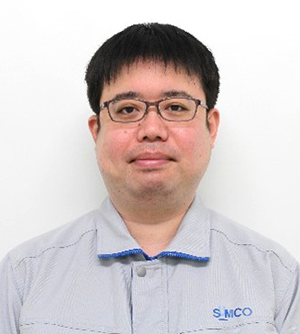
Ryo Hirose
Customer Product Engineering Department
Q1. You earned your doctorate from Kyoto University. What made you decide to obtain an advanced degree?
I was interested in acquiring more extensive academic expertise to enhance the quality of the development work I was conducting at the time. Then I took part in an international conference on a specialized field of knowledge that related to my job; I had applied to present a paper at the conference at the encouragement of my supervisor. There, I met someone who knew the professor who would later be my thesis supervisor, and that person recommended me.
Q2. What were the advantages of studying to get a degree? Did you struggle at all?
The biggest advantage was having time to discuss things in depth with academic specialists. While there’s time to ask questions about a paper at a conference, it’s limited. At a university research lab, though, you can engage in debate anytime—and that was a great learning experience.
On the other hand, I had to write a thesis to obtain my doctorate. Academic writing has distinctive turns of phrase and specialized terminology, which I really struggled to master. I would pore over past papers in the same field and repeatedly got my university professors to correct papers I had written.
Q3. How have you applied what you learned earning an advanced degree? How do you plan on applying it going forward?
My field of research was closely related to the development work I was conducting at the time, and what I learned made a difference right away. Writing a thesis also taught me how to organize my thoughts on the page, and presenting papers in settings like academic conferences honed my ability to prepare documentation that would make sense to anyone. These are the kinds of skills that I intend to apply on the job going forward, both in-house and beyond.
Q4. What message do you have for younger engineers following in your footsteps?
If you have the opportunity to pursue an advanced degree while you are still young, you should seize it. Sure, it takes courage to put your name forward. You may wonder what you might do if you fail to complete the degree. But if you have the opportunity, go ahead and seize it. Even if you fall short, you can easily bounce back, especially if you are still young—and you will learn a lot.
Interacting with people from various career backgrounds and walks of life will expand your horizons, too. I would strongly recommend it.
Voice
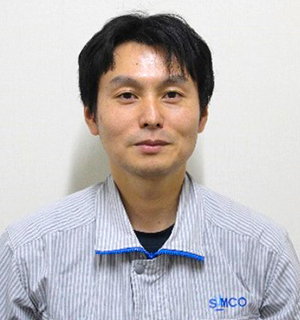
Shun Sasaki
Advanced Evaluation & Technology Development Department
Q1. You spent two years conducting research at the State University of New York. How did you end up applying to study abroad?
I knew that SUMCO had affiliated companies with offices overseas, and I had dreams of working at one of them. But then I discovered that, being with the Advanced Evaluation & Technology Development Department, I had little chance of working at an affiliate. The director of the department at the time then told me about the overseas study program. I was interested, so I ended up applying.
Q2. How has being sent overseas changed you?
At universities in the United States, there are many international students from around the world, including China and India, and they all swap information with each other—regardless of what research lab they are with—as they do their research. That is the impression I got. Seeing that, I realized that America’s technological prowess in semiconductor devices comes in part from the how the diversity of its talent leads to broader perspectives. I had previously believed that the main factor behind America’s position in the field was the sheer difference in the quality and quantity of technologies it develops. So the experience altered my perception.
As for day-to-day life, there were many people around willing to help me out, so I stopped worrying too much when I had problems. I got into the habit of thinking positively, telling myself that things would work out. I suppose I became more flexible in my thinking.
Q3. How have you applied what you learned at the State University of New York?
Part of my research involved evaluating the performance of semiconductor devices. There are not that many opportunities to learn about semiconductor devices in-house, so the knowledge I gained from my research has served me well on the job.
In addition, my time as a researcher improved my language skills. When using English on the job, I now have a better understanding of what people are saying.
Q4. What message do you have for younger engineers who may be thinking of applying to study abroad?
There is a big difference between being told what a foreign country is like and actually seeing it for yourself. Everything you experience studying abroad will be an eye-opener. I imagine there are people out there who are interested in studying abroad but are hesitant to apply because they feel uneasy about living overseas. You don’t need to be overly worried, though. The company is there to support you, and in my case, the local students helped me out. If you think you might want to take the plunge, I would definitely urge you to apply.
Diversity, Equity & Inclusion
SUMCO believes that the promotion of diversity, equity and inclusion is essential for becoming the strong company which can grow sustainably. Since our company has three roots: Mitsubishi, Sumitomo, and Komatsu, we have fostered a culture in which we can bring together and utilize the knowledge and expertise of each. In addition to this, we work to further enhance our corporate value so that diverse talents can work to utilize their ideas and experiences by expanding measures to promote women’s career and systems, local hires at our domestic and overseas bases and experienced workers of other companies, so that diverse talents can work to utilize their ideas and experiences. We will continue to actively promote diversity, equity and inclusion initiatives to meet our stakeholders’ expectations.
Supporting the Development of the Next Generation・Promoting Active Participation of Women
To provide company-employees who raise children with a more comfortable workplace environment and to support their work-life balance, SUMCO and Group companies in Japan are consistently striving to create an environment in which it is easy for women to work by establishing diverse employment support programs such as longer child-care leave period than the statutory leave period, a telework system, and a short working hour system. In 2016, as part of these efforts, the Company has established the SUMCO Nursery School Imari as an on-site day-care facility at our Kyushu Plant in the Imari area, the largest site across the SUMCO Group. We also provide a childcare support allowance for company-employees who are unable to use the SUMCO Nursery School Imari.
- As a new form of regional contribution, the facility is a community day-care service based on the Japanese government's Comprehensive Support System for Children and Childrearing. Accordingly, a portion of the capacity is made available to local residents who are not SUMCO employees.
Additionally, we improve support for women company-employees by developing a “Retiree Comeback Program” that allows company-employees who are forced to leave the company temporarily due to childcare or other reasons to return to work again. These initiatives have been recognized, and we have obtained the Kurumin Certification mark, which is awarded to companies that support the development of the next generation. To further increase diversity within the company and to further promote women’s participation, we have set a medium-term goal of increasing the percentage of female managers to 10% in SUMCO* and 12% on a consolidated basis (in SUMCO Group) by 2030, and actively promote regular and experienced female company-employee hiring. We also offer training to support career development for female employees, roundtable discussions with female executives, and diversity management training for managers supervising female employees. Through these initiatives, we aim to create an environment where women can thrive with confidence.
- Total figures include the number of SUMCO employees assigned to other companies and exclude secondees to SUMCO Corporation from other companies.
Goals:Percentage of woman in management positions
(SUMCO*, the end of December 2021) 1% → 2030: 10%
(Group, the end of December 2021) 6.5% → 2030: 12%
Support programs for each life event
-
FY2025 Number of Employees
Taking Childcare LeaveNumber of Employees
Taking Family Care LeaveMale 105 1 Female 18 0 -

| Program | Name of policy measure | Description |
|---|---|---|
| Childcare support | Childcare leave | Eligible up to the last day of the month when child is 3 years old |
| Childcare leave at the time of birth | Up to 4 weeks of paternity leave within 8 weeks after the child's birth, which can be divided into 2 periods | |
| Shorter workdays during childcare | Up to time child enters junior high school, choice of 4-hour or 6-hour workdays | |
| Flexible work hours | Up to time child enters junior high school, free arrangement of work times during the day adding up to a normal workday of 7 hours 45 minutes | |
| Work from home (remote work) option | Employees in a department and work category enabling them to work from home may choose to work remotely, as their circumstances warrant, at a maximum until child enters junior high school | |
| Special paid time off | Up to time child enters junior high school, in addition to the legally mandated time off for care of an ill child, paid time off can be taken for the necessary number of days when care for an illness is needed | |
| SUMCO Nursery School Imari | A nursery school on the company premises, available also to children of employees within access range | |
| Childcare support allowance | Employees outside the range of access to SUMCO Nursery School Imari can receive monthly grants of 10,000 to 20,000 yen up to the last day of March coming after child is 3 years old | |
| Family care support | Family care leave | Leave for care of a family member can be taken for a total of one year in up to three installments |
| Shorter workdays during family care | A choice of 4-hour or 6-hour workdays (for a total of up to three years; can be divided into multiple installments) | |
| Flexible work hours | Free arrangement of work times during the day adding up to a normal workday of 7 hours 45 minutes (for a total of up to three years; can be divided into multiple installments) | |
| Special paid time off | In addition to the legally mandated time off for family care, paid time off can be taken for the necessary number of days when family care is needed | |
| Work from home (remote work) option | Employees in a department and work category enabling them to work from home may choose to work remotely, as their circumstances warrant | |
| Other support | Special time off when spouse gives birth | When a spouse gives birth, a total of 3 days of paid time off within 10 days before and after birth |
| Return-to-work program for former employees | Former employees who had to leave their job behind for personal reasons such as childcare or family care, and who wish to return, can do so by following the set procedures |
SUMCO Nursery School Imari Celebrates 10th Anniversary
-
SUMCO Nursery School Imari, an on-site day-care facility at our Kyushu Plant in the Imari area, is celebrating its 10th anniversary. Established in November 2016 as part of our efforts to help employees with young children strike a balance between work and parenting, the facility has served a total of 286 working parents to date. In addition, some of the enrollment spaces are open to local residents who are not SUMCO employees as part of our corporate commitment to the community.
-
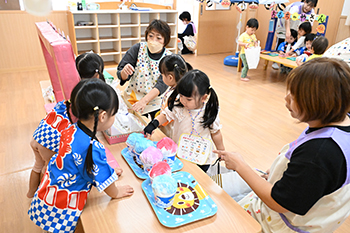
Voice of the User
The K Family, Kyushu Factory
Q1. Having used SUMCO Nursery School Imari yourself, what are your impressions of it? How do you think it can help strike a balance between work and parenting?
I live in Imari, and the local government has taken steps to make sure that there are zero children on the day-care waiting list. Still, the company has its own fully equipped day-care facility near the factory, which I am really grateful for. You can tell the day-care staff genuinely care. I feel completely safe leaving my children with them.
With a day-care facility right there ready and waiting, my arrangements to return to work after having my baby went so smoothly. The nursery is close to the factory, so if they call me because of a sudden fever or other reason, I can just go. Every room has a camera, too, so I can monitor what my boys are doing in real time. That makes me feel secure leaving them there. I often talk with the other parents about the generous portions and high quality of the meals, which are another thing to be thankful for. They help keep my boys healthy.
Q2. How have programs like childcare leave or support from your workplace been helpful?
When we had our first son, I took a month’s childcare leave, which was a good lesson in how much work parenting is. My plan is to continue parenting alongside my wife. Right now, I work flextime so I can take my boys to nursery school and pick them up.
I work flexible hours (8:30 a.m.–5:15 p.m.). Flexible work hours are convenient for doing my job, and my workplace is understanding of the arrangement. Another helpful program is special paid time off, which employees can claim by the hour for hospital visits.
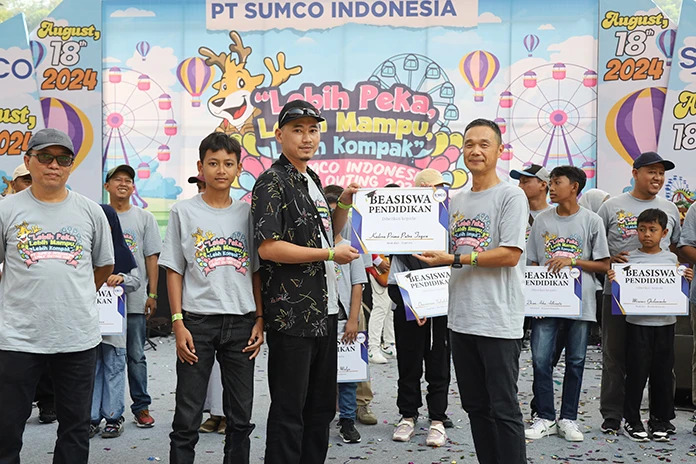
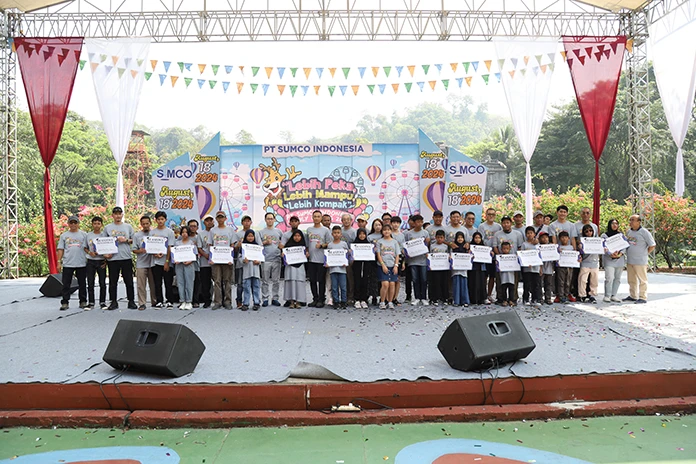
With a view to fostering high-quality human resources, PT.SUMCO Indonesia also offers a scholarship program for the children of its company-employees. We hope that this scholarship will contribute to the future development of Indonesia.
(Photo: Scholarship program event at PT.SUMCO Indonesia)
Employment of People with Disabilities
-
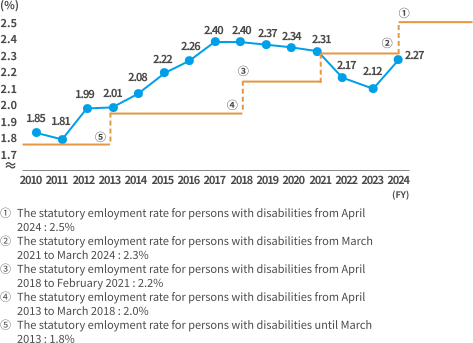
Employment Ratio of People with Disabilities (SUMCO Group [Japan])
-
The SUMCO Group is actively working to employ persons with disabilities across the entire group, as demonstrated by SUMCO establishing a company that specifically hires persons with disabilities in Japan. As of the end of December 2025, the employment rate of people with disabilities in Japan and overseas was 1.90%. In Japan, the actual employment rate was 2.58%, exceeding the statutory employment rate of 2.5%.
Employment of Older Workers
We have set up a re-employment system by which company employees who wish to continue working after mandatory retirement at age 60, can basically continue working until age 65 under the same treatment and conditions applied at the time of retirement.
Utilization of Global Talent
The SUMCO Group maintains manufacturing plants in the US, Taiwan and Indonesia, as well as sales offices around the world. By utilizing local hiring and actively working to hire and utilize talented global human resources regardless of nationality. The SUMCO Group seeks to achieve even further growth as a global company by improving each other.
Number of Employees
(People)
| Item | Actual at end of 2025 | ||
|---|---|---|---|
| Consolidated | SUMCO* | ||
| Regular employees | Total number of people | 9,714 | 4,877 |
| Male | 8,655 | 4,385 | |
| Female | 1,059 | 492 | |
| Percentage of female | 10.9% | 10.1% | |
| Managers | Total number of people | 966 | 610 |
| Male | 881 | 594 | |
| Female | 85 | 16 | |
| Percentage of female | 8.8% | 2.6% | |
| Item | SUMCO | Remarks | |
|---|---|---|---|
| Board member | Total number of people | 13 | As of Mar. 31, 2026 |
| Male | 10 | ||
| Female | 3 | ||
| Percentage of female | 23.1% | ||
| New employee | Total number of people | 114 | FY2025 |
| Male | 84 | ||
| Female | 30 | ||
| Percentage of female | 26.3% | ||
| Average years of service (years) | Male | 14.5 | As of Dec. 31, 2025 |
| Female | 10.2 | ||
| Difference | 4.3 | ||
- Total figures include the number of SUMCO employees assigned to other companies and exclude secondees to SUMCO Corporation from other companies.
| Item | Regular employees(As of Dec. 31, 2025) | Temporary employees(2025 average) | |
|---|---|---|---|
| SUMCO | 5,065 | 386 | |
| Consolidated | 9,714 | 769 | |
| Japan | 7,163 | ||
| Overseas | 2,551 | ||
-
Number of Employees by Region (Consolidated)
(People)
Region Number of employees
(As of Dec. 31, 2025)Japan 7,163 North America 713 Southeast Asia 317 East Asia 1,492 Europe 29 Total 9,714 -
Breakdown of Employees (Consolidated)
(People)
Managers General employees Total
(As of Dec. 31, 2025)Male 881 7,774 8,655 Female 85 974 1,059 Total 966 8,748 9,714
2025 Data
| Number of reporting and consultation cases related to harassment | 35 | |
|---|---|---|
| Number of participants in harassment training on e-learning | 7,743 | |
| Resignation rate for personal reasons among permanent employees (graph below shows the change in the past turnover rate) | 1.87% | |
| Leave rate* | 0.45% | |
| Human resource development | Total hours of company-wide training held by the Human Resources Dept. | 31,451 hours |
| Total cost | 212 million yen | |
| Percentage of employees who attended the above training | 34.0% | |
| Training hours per employee | 9.5 hours | |
| Percentage of persons with disabilities employed | Global Total | 1.90% |
| Japan Only | 2.58% | |
- The rate calculated by dividing the number of employees on leave from January 2025 to December 2025 by the number of employees at the end of 2025
Change in resignation rate among permanent employees
| 2021 | 2022 | 2023 | 2024 | 2025 | ||
|---|---|---|---|---|---|---|
| Resignation rate for personal reasons | 0.85% | 0.91% | 1.21% | 1.40% | 1.87% | |
| Men | 0.76% | 0.88% | 1.12% | 1.34% | 1.84% | |
| Women | 1.88% | 1.23% | 2.21% | 1.91% | 2.14% | |